


Unlocking Power and Precision: Why Hip Mobility Is the Asheville Martial Artist’s Secret Weapon
Whether you are stepping onto the mats for Brazilian Jiu-Jitsu, sparring in Muay Thai, or practicing traditional karate katas, martial arts demand explosive force, sharp reflexes, and durability.
When athletes want to hit harder, kick higher, or grapple more effectively, they often focus on brute strength or endless conditioning. However, in physical therapy, we look at the central axis connecting your upper and lower body: the hips.
Hip mobility isn’t just about being flexible enough to do the splits. It is the bedrock of force transfer, balance, and injury prevention. Here is a look at why your hips dictate your martial arts performance, and how you can train them to move better.
At its core, proper hip mobility allows the body to transfer force efficiently through the kinetic chain while seamlessly adapting to dynamic angles, stances, and body shapes. When hip motion becomes restricted, the body instinctively seeks path-of-least-resistance workarounds, forcing unnecessary stress onto neighboring structures. Over time, these compensatory movement patterns significantly elevate strain on the lower back, knees, and shoulders, leading to premature fatigue and heightened risk of injury.
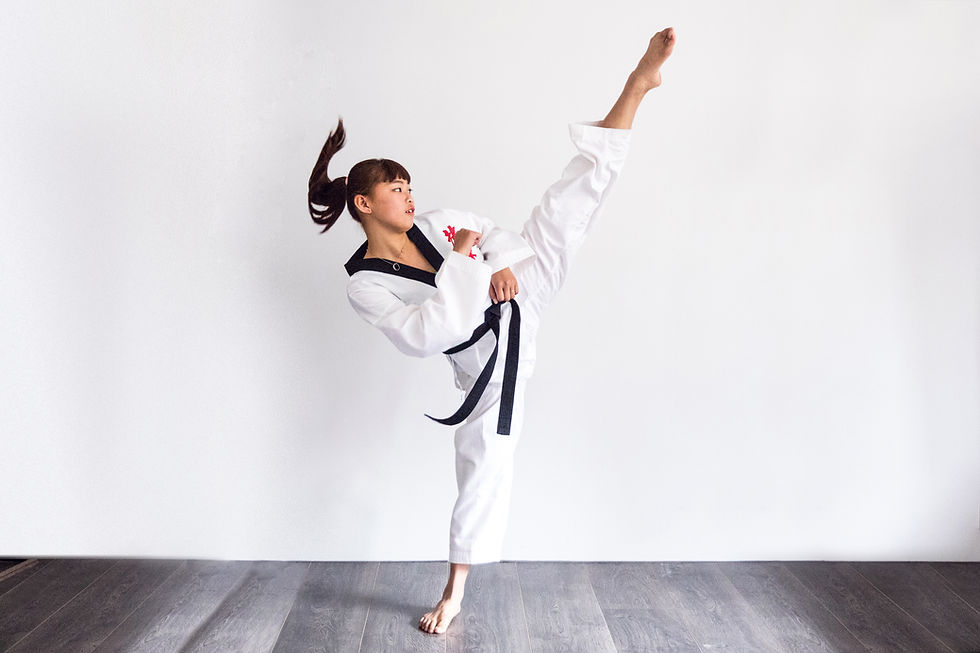
1. High Kicks and Fluid Footwork: Dynamic Range of Motion
Kicking is the most obvious area where hip mobility makes or breaks performance, but the mechanics go deeper than hamstring flexibility.
A high roundhouse kick or side kick requires a complex coordination of:
Hip abduction: Opening the leg out to the side.
Internal and external rotation: Rotating the femur inside the hip socket.
Opposite-side stability: The standing leg must rotate smoothly while stabilizing your entire body weight.
Real-World Example: The Head-Level Roundhouse Kick
When throwing a roundhouse kick, the primary driver isn't just lifting the kicking leg—it is the pivot on the lead/supporting foot and hip.
If the standing hip lacks internal rotation, the pelvis cannot turn over completely. To compensate, a fighter will lean their upper body backward and crunch through the lumbar spine. Over time, this leads to lower back pain, hip impingement (femoroacetabular impingement), and kicks that telegraph early and land without authority. With open, mobile hips, your pelvis turns freely, allowing the kick to whip up to head height while keeping your torso balanced and ready to defend.
2. Striking and Takedowns: The Power Center of the Kinetic Chain
Power doesn’t originate in the fist or the shoulder. It begins at the ground, moves through the legs, and gets amplified by the hips before it reaches your hands. This is the kinetic chain.
The Heavy Cross (Punching Mechanics) Unlocking Power and Precision: Why Hip Mobility Is the Asheville Martial Artist’s Secret Weapon
Consider a fundamental boxing cross or reverse punch:
The rear foot pushes against the canvas.
The rear hip rapidly extends and rotates internally, driving the pelvis forward.
This rotational torque transfers through the core and into the shoulder and fist.
If your rear hip is tight, especially into hip extension and internal rotation, that kinetic chain breaks down. Instead of driving with the large gluteal and pelvic musculature, the body compensates by over-relying on the rotator cuff and shoulder girdle, drastically reducing punching power and raising the risk of shoulder strain.
Takedowns and Grappling Leverage
In grappling disciplines like Brazilian Jiu-Jitsu and Judo, hip mobility dictates leverage, defensive framing, and the ability to dictate position on the ground:
Guard Retention and Inversions (Open Guard/De La Riva): When playing off your back, hip mobility, specifically deep flexion paired with abduction and external rotation, is what prevents an opponent from passing your guard. If an opponent attempts a toreando or knee-cut pass, a mobile grappler can high-pummel their leg, hooking their foot back onto the opponent’s hip or bicep without shifting their entire torso. Rigid hips force you to compensate by over-flexing the cervical and thoracic spine into dangerous inversion angles, drastically increasing neck strain while creating gaps for your guard to be smashed.
Hip Throws (Harai Goshi or O Goshi): Getting your hips lower than your opponent’s center of gravity requires fluid, rapid hip flexion and lateral translation. The fighter with superior hip mobility gets under the opponent’s center of mass effortlessly, turning their body into an efficient fulcrum to launch the throw with minimal upper-body exertion.

3 Exercises to Build Resilient, Mobile Hips
These three physical-therapist-approved mobility drills focus on active control and rotation, preparing your joints for the specific demands of combat sports.
This movement targets internal and external rotation simultaneously, the exact rotations needed to pivot during kicks and punch through the hips.
How to do it: Sit on the floor with your knees bent at 90 degrees, one leg in front (external rotation) and one leg to the side (internal rotation). Keep your chest upright.
The Movement: Without using your hands for support if possible, lift your knees and sweep them across to the opposite side, maintaining the 90-degree angles until you reach the mirror position. To make this more advanced, you can then try to press yourself up to kneeling from there and add a rotation as this video shows.
Dose: 8–10 slow, controlled transitions per side.
Hours of sitting tighten the psoas and rectus femoris, which blunts rear-hip extension during punches and takedown drives.
How to do it: Kneel on your back knee with the front foot planted flat at a 90-degree angle. Tuck your tailbone under (posterior pelvic tilt) to engage your glute on the kneeling side.
The Movement: Gently shift your weight forward until you feel a stretch along the front of the trailing hip. Reach the arm on the kneeling side straight up and gently lean and rotate toward the front-leg side.
Dose: Hold for 30–45 seconds per side for 2–3 repetitions.
Martial artists need hip mobility in deep knee bends for scrambling on the ground and staying low in a fighting stance. Unlocking Power and Precision: Why Hip Mobility Is the Asheville Martial Artist’s Secret Weapon
How to do it: Drop into a deep goblet or bodyweight squat. Keep your heels down and chest tall.
The Movement: Place your hands together or hold a stable pole/rig. Gently drop one knee inward toward the floor, rotating the femur into internal rotation, then return to center and repeat on the other side.
Dose: 6–8 gentle rotations per side.
The Takeaway
Flexibility is passive; mobility is active and controllable. By dedicating 10 minutes before and after training to open your hip joints and reinforce active end-range control, you will kick higher, hit harder, protect your lower back, and extend your longevity on the mats.
At Outshine PT & Fitness, we work with martial artists and athletes of all levels. We look at how your hips move during kicks, punches, and rolls. Then we build a plan to help you move better, hit harder, and stay in the game longer.


Comments